I get this question at least once a week from buyers, Amazon sellers, and startup founders: “How do I find a good earbuds manufacturer China actually has, without getting burned?” And honestly, it’s a fair question, because the earbuds manufacturing landscape in China is massive, fragmented, and full of both legitimate factories and middlemen dressed up as factories.
I’ve spent enough years in this space — sourcing, vetting suppliers, sitting through factory tours in Shenzhen and Dongguan, going back and forth on samples that didn’t quite hit spec — to have some strong opinions on what separates a real manufacturing partner from a supplier who’s just going to cause you headaches six months into your product launch.
Why “Earbuds Manufacturer China” Is Such a Loaded Search Term
When people type this into Google, they’re usually at one of two stages. Either they’re brand new to hardware sourcing and just trying to understand who’s out there, or they’ve already been burned once — bad QC, missed MOQs, a factory that ghosted after the deposit — and they’re searching again, more cautiously this time.
The reality is that the Pearl River Delta (Shenzhen, Dongguan, Huizhou) is home to probably 80% of the world’s TWS earbuds production capacity. That’s not an exaggeration. The chipset ecosystem alone — Qualcomm QCC series, Airoha, Bestechnic (BES), Jieli — is concentrated here, along with the acoustic component suppliers, the injection molding shops, and the assembly lines that can turn a spec sheet into a finished product in a matter of weeks.
But “concentrated” doesn’t mean “easy to navigate.” I’ve seen buyers get quoted by trading companies who don’t own a single production line, just relationships with three or four factories they subcontract to. Nothing inherently wrong with that model, but if you think you’re talking directly to a manufacturer and you’re not, your pricing, your MOQ flexibility, and your QC oversight all suffer.
What Actually Separates a Real Factory From a Reseller
This is where I tell people to slow down and ask uncomfortable questions before signing anything:
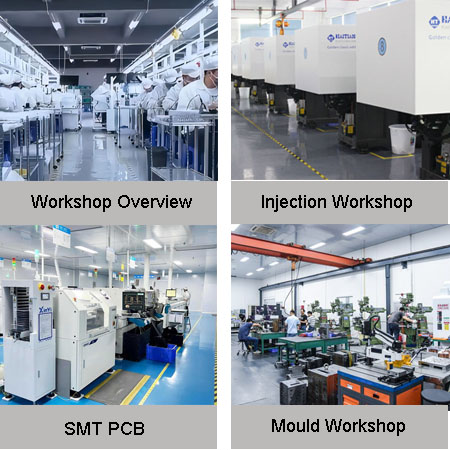
Can they show you real production capability? Not just photos — ask about their SMT lines, their assembly capacity per day, whether they do their own tooling for earbuds shells and charging cases. A factory like Tashells Audio, which I’ve worked closely with on several projects, owns its full production chain from PCBA to final assembly, which means when something goes wrong in production, there’s actually someone accountable who can fix it on the line — not three phone calls removed.
Do they understand certifications, or just claim to? FCC, CE, RoHS, BQB, UKCA, UN38.3 for the batteries — these aren’t optional checkboxes, they’re what determines whether your shipment clears customs or sits in a warehouse accumulating fees. A manufacturer who can walk you through their certification process without hesitation has done this before, many times.
What’s their actual OEM/ODM capability? There’s a real difference between a factory that can slap your logo on an existing shell design (OEM) and one that can take your spec sheet — custom driver size, specific ANC/ENC configuration, a particular codec requirement — and engineer it from scratch (ODM). If you want something differentiated in a crowded Amazon category, you need the latter.
The Custom TWS Earbuds Conversation Nobody Warns You About
If you’re going the custom TWS earbuds route, budget more time than you think you need. Tooling alone for a custom shell design can take three to four weeks, and that’s before you get into acoustic tuning, which — if the factory is doing it properly — involves multiple rounds of sample iteration. I’ve worked with Tashells Audio on projects where we went through four or five acoustic tuning rounds before the low-end response was where the client wanted it. That’s not a delay, that’s the process working correctly.
Where I see buyers get impatient is in wanting to skip straight to mass production after one sample round. Don’t do that. One sample tells you almost nothing about consistency across a 5,000-unit run. Ask for pre-production samples pulled from an actual production line, not hand-assembled by an engineer in a lab.
MOQ, FOB Pricing, and the Questions That Actually Matter
Every factory quotes MOQ and FOB pricing differently, and honestly, the number on a quote sheet means very little until you understand what’s baked into it. Does the FOB price include your custom packaging? Your logo laser-etching? Is the MOQ based on one SKU or does it flex across color variants?
I always tell people: get the full cost breakdown in writing before you get emotionally attached to a low headline price. A factory quoting $0.50 less per unit but charging separately for tooling, packaging, and testing can end up more expensive than one with a transparent, slightly higher all-in number.
Where This Leaves You
If you’re actively looking for an earbuds manufacturer China-based that can handle both OEM and ODM work, my honest advice is this: talk to at least three factories, ask the uncomfortable questions above, and pay close attention to how quickly and specifically they answer. Vague answers about capability usually mean vague accountability down the line.
I’ve built a lot of my sourcing relationships around factories like Tashells Audio precisely because the answers to those questions were concrete from the first conversation — actual production numbers, actual certification documentation, actual engineers on calls instead of just sales reps repeating a script. That’s really what you’re looking for, more than any single spec on a datasheet.
Happy to go deeper on any part of this — tooling timelines, chipset selection, certification specifics — if it’s useful for whatever you’re currently sourcing.